Heavy Rain and Gutter Guards in Archer: What to Expect During Storm Season
Storm season in and around Archer has a way of exposing every weak point in a gutter system. A stretch of dry weather can make everything look fine from the ground. Then the summer rain arrives, the roof starts shedding water fast, and suddenly the trouble shows up all at once. Overflow at the corners. Water shooting past the gutters. Downspouts backing up. Mulch displaced. Soil washing out near the foundation.
That pattern is familiar across Central and North Florida. In places like Archer, Gainesville, Newberry, Ocala, Lady Lake, Wildwood, and Fruitland Park, the challenge is not just rain. It is heavy rain combined with humidity, yard debris, and the kind of seasonal buildup that can turn a decent system into an overwhelmed one in a single afternoon.
Homeowners often assume gutter guards solve everything. They can help, sometimes a great deal. But they are not magic, and storm season is when the difference between realistic expectations and wishful thinking becomes obvious.
What heavy rain really does to a gutter system
A gutter system has one basic job: catch roof runoff and move it away from the house in a controlled way. During Florida storm season, that simple job gets harder. The roof sheds water quickly, especially in intense summer downpours. If the troughs are partially blocked, if the downspouts are not clearing efficiently, or if the discharge area is already saturated, the whole system can start to lag behind the rain.
That is why storms reveal problems that stay hidden in milder weather. A small amount of organic buildup may not matter in a light shower. Under a hard downpour, though, leaves and needles can mat together and slow the flow. Water takes the path of least resistance. Sometimes that means spilling over the front edge. Sometimes it means running behind the gutter if the water is not being captured cleanly. Sometimes it means backing up around a corner or at the top of a downspout.
Florida maintenance guidance consistently points back to the same issue: gutters and downspouts need cleaning as needed, and organic buildup needs to be removed, especially in summer. That is not glamorous advice, but it is dependable.
Why Archer homes are especially vulnerable during storm season
Archer sits in the same broader weather pattern that affects nearby Gainesville and much of North and Central Florida. Summer rainy season, tropical weather, humid conditions, and bursts of runoff all create stress. Add in common Florida yard debris, especially pine needles, leaves, and acorns, and it becomes easy to see why so many systems struggle right when they are needed most.
UF/IFAS guidance on storm preparation specifically warns that gutters and storm drains can clog with debris and recommends clearing needles, leaves, and other material from roofs and gutters. That lines up with what homeowners already notice on their own properties. A roof may collect a mix of fine debris that does not seem like much until it drifts into a valley, slides toward the gutter line, and packs itself at a downspout opening.
Live oak leaves and acorns create another layer of trouble. They do not just clog gutters. When they wash off with stormwater, they can contribute to runoff problems beyond the house. Keeping that debris from building up in the first place is good maintenance for the home and smarter stormwater practice overall.
Gutter guards help, but they do not remove maintenance
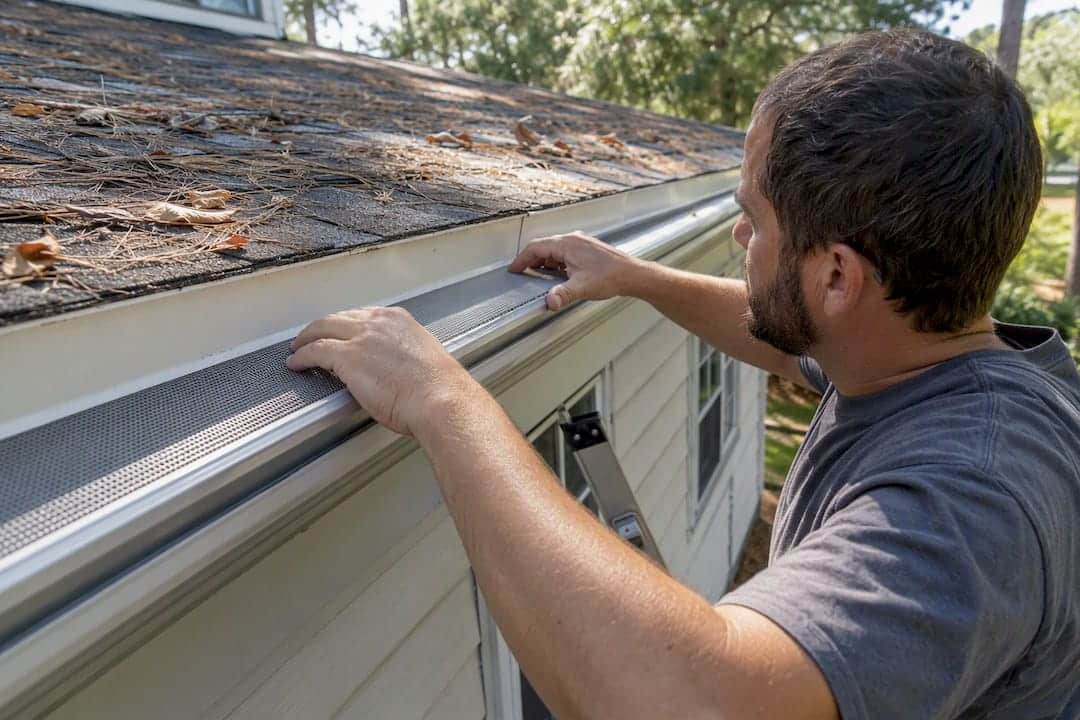
This is the part many people need to hear clearly. Gutter guards can reduce how much debris gets into the trough. They can make cleaning easier. They can help a system stay more functional between service visits. What they cannot do is eliminate all maintenance or guarantee perfect performance in every storm.
That matters a lot in Florida, where pine needles are a frequent headache. Homeowners shopping for gutter guards for pine needles Florida properties often hope for a one-and-done answer. In practice, pine needles are tricky because they are thin, persistent, and easily carried by wind and runoff. Depending on the guard design, they may be blocked effectively, they may collect on top and need to be brushed off, or some portion may still find its way into the gutter over time.
The same goes for leaves and small organic matter. Guards often change where debris gathers rather than making debris disappear. Instead of filling the inside of the gutter, material may accumulate on top of the guard, near roof edges, or around valleys where water concentrates. During a heavy rain, that buildup can still interfere with flow.
A realistic expectation is better than a sales pitch. Gutter guards are best seen as a maintenance reducer, not a maintenance replacement.
What to expect from gutter guards when the rain gets intense
When a guarded system performs well in storm season, the improvement is usually pretty obvious. Water enters the gutter more consistently, downspouts stay clearer, and the system keeps up longer before overflow starts. That is the good scenario.
There are also trade-offs. In very heavy rain, some guard systems may not handle peak water volume as cleanly as homeowners expect. The issue is not always clogging. Sometimes it is simply a matter of water moving off the roof so fast that capture becomes less efficient. This is one reason conversations about storm ready gutters Florida homes need to go beyond the guard itself. The guard, the gutter profile, the downspout layout, and the discharge path all work together.
If one piece is undersized or poorly maintained, the rest of the system can still struggle.
Debris is only half the story, drainage is the other half
A gutter can be clean and still not perform well if the water has nowhere to go once it enters the system. This is where downspouts become the overlooked part of storm preparation.
In many homes, the visible problem is overflow at the gutter edge, but the root cause is restricted or ineffective drainage below. If the downspout is blocked, if the elbow is packed with organic sludge, or if discharge near the base cannot move water away fast enough, rain will back up through the system. The homeowner sees the top failing, but the choke point is lower down.
People looking into downspout drainage Newberry FL properties, or anywhere nearby with similar weather, often discover that the gutter itself was not the whole problem. The drainage path matters. Water should leave the roofline efficiently and discharge in a way that does not create erosion, splash-back, or concentrated runoff right against the house.
Florida code guidance reinforces this bigger-picture view. Gutters and downspouts must be sized and discharged in accordance with the Florida Building Code and Plumbing requirements. That means sizing is not just about buying a common profile and hoping for the best. It is about matching the system to the home and making sure water is directed properly.
The sizing question homeowners ask, and the answer they usually need
Homeowners often start with a simple search for gutter sizes for Florida homes. That is understandable. People want a quick answer. The problem is that the right size depends on more than location alone.
Florida receives heavy rain, but roof area, roof shape, slope, runoff concentration, and downspout placement all affect performance. A system that works on one house may be overwhelmed on another house next door. That is why code-based sizing and discharge matter more than generic rules of thumb.
The same caution applies when comparing styles. Some homeowners ask about K-style gutters Lady Lake FL contractors install, while others compare seamless gutters Ocala FL companies offer. Those are reasonable shopping terms, but the practical question is not which phrase sounds familiar. The real question is whether the system is properly configured for the home, securely fastened, made from appropriate materials, and maintained well enough to handle storm conditions.
That may sound less exciting than a product brochure, but it is the kind of answer that holds up once the sky opens.
Materials and fastening matter more in Florida than many people realize
Florida code materials for exterior gutters and leaders call for metal or approved plastic, securely fastened with corrosion-resistant fasteners. That requirement points to a reality every Florida homeowner eventually sees: hardware and materials take a beating in humid, wet conditions.
For many homes, aluminum gutters Central Florida homeowners consider are a practical option because metal systems are widely used and need to hold up in repeated wet-dry cycles. What matters most is not the marketing label. It is whether the installation is secure, whether corrosion resistance was taken seriously, and whether the system stays intact when storms put weight and force on it.

Loose fasteners, sagging runs, and shifting pitch can all reduce performance long before a gutter fully fails. Sometimes a house does not need a full replacement. It needs a careful repair and re-securing of the parts already there. In other cases, age, damage, or repeated overflow problems push the conversation toward a larger upgrade.
Signs your system may not make it through storm season gracefully
Most homeowners do not inspect their gutters closely until something goes wrong. That is normal. But a few warning signs are worth taking seriously before the heaviest weather sets in.
- Water spilling over the front edge during rain
- Plants or visible debris growing from the gutter line
- Sagging sections or separated joints
- Downspouts that drip slowly after a storm instead of clearing promptly
- Erosion or washout below discharge points
None of those signs automatically means the whole system must be replaced. They do mean the system needs attention. Sometimes gutter repair Wildwood FL homeowners seek turns out to be straightforward cleaning and drainage correction. Sometimes it reveals hidden damage, poor fastening, or a layout that never handled runoff well to begin with.
When cleaning is enough, and when it is not
Routine cleaning solves more problems than people think, especially before and during storm season. If the issue is accumulated leaves, pine needles, acorns, or organic muck, clearing the troughs and downspouts can restore a lot of function quickly. Gutter cleaning Fruitland Park FL searches spike for a reason during wetter parts of the year. Debris is common, and it does not take much to interfere with flow.
Still, cleaning has limits. If water keeps overshooting the gutter after the debris is removed, the issue may be capture, pitch, fastening, or sizing. If the gutter drains but the area below turns into a muddy trench, discharge management needs work. If joints leak repeatedly or sections pull away, repair may not hold for long.
This is where judgment matters. A homeowner who cleans faithfully can still end up with a system that is wrong for the house or worn past the point of efficient service. On the other hand, replacing a system that only needed a thorough cleaning and a downspout fix is an expensive way to solve the wrong problem.
Repair versus replacement in the real world
The line between repair and replacement is rarely dramatic. More often, it is cumulative. One leaking corner is a repair. One loose section is a repair. A single storm-damaged run may be a repair. But once several sections sag, joints keep failing, and water management remains poor after cleaning, replacement enters the conversation for practical reasons, not cosmetic ones.
Homeowners looking into gutter replacement Gainesville FL services are often reacting to repeated storm performance issues rather than one catastrophic event. They are tired of seeing the same trouble every rainy season. The right replacement can simplify maintenance and improve reliability, especially if it addresses both debris control and discharge.
Seamless gutters Ocala FL shoppers compare are often part of that broader conversation, but the key idea remains the same wherever the home is located: the value of replacement depends on whether it corrects the causes of failure, not just the appearance of the old system.
What a smart pre-storm inspection usually focuses on
A useful inspection does not need to be complicated. It needs to be honest. Before peak storm season, attention should go to the areas where water and debris collect first, and where backups show up fastest.
- Roof edges and valleys where needles and leaves gather
- Gutter runs with visible sagging or standing debris
- Downspout openings and elbows where clogs form
- Discharge areas near the foundation or landscape beds
- Fasteners and attachment points that may have loosened
That short review catches many problems before a hard rain magnifies them. It also makes service calls more productive because the homeowner can describe patterns instead of just saying, "the gutters do not work."
The pine needle problem deserves its own mention
Florida homeowners with pines nearby often deal with a finer, more stubborn kind of debris than broad leaves alone. Pine needles can drift into every transition point in a gutter system. They catch at guard openings, tangle near downspout entrances, and mix with roof grit into a dense mat once moisture gets involved.
UF/IFAS guidance notes pine needles among the common materials that should be kept on-site as mulch rather than allowed to wash away. That advice reflects a simple truth. Once those needles start moving with rainwater, they do not help the landscape or the gutter system. They become part of a clog or runoff problem.
For that reason, homeowners choosing gutter guards for pine needles Florida properties should ask less about miracle claims and more about maintenance behavior. How easy is the system to inspect? Where does debris collect? What happens after a windy week followed by a hard storm? Those are the questions that matter in real life.

Hiring the right help makes a difference
Storm season has a way of creating urgency, and urgency can lead to poor decisions. When hiring a gutter contractor Florida homeowners should look for practical, code-aware thinking rather than flashy promises. A good contractor should be able to talk plainly about cleaning, repair, sizing, discharge, materials, and fastening, not just sell a guard or a replacement package.
This is especially important because many gutter problems overlap. Debris control, structural fastening, and drainage all affect each other. A contractor who only looks at the visible overflow may miss the buried issue. A contractor who insists every system needs guards may be skipping the more basic need for cleaning or downspout correction. A contractor who pushes replacement without discussing drainage may be replacing hardware while leaving runoff problems intact.
The best conversations are usually the least theatrical. They involve looking at where the water goes, where debris gathers, how often maintenance is needed, and whether the current system is realistically capable of handling local conditions.
Small maintenance choices can prevent bigger storm headaches
Florida storm prep advice often focuses on the dramatic parts of the season, but a lot of success comes from ordinary maintenance done on time. Clearing debris from roofs, gutters, and nearby storm drains can improve how a home handles heavy weather. Keeping leaf litter and yard debris from washing into runoff paths also helps reduce downstream mess and pollution concerns.
That means the best storm-season routine is usually not complicated. It is consistent. If the property drops a lot of leaves, needles, or acorns, inspection frequency should rise accordingly. If a recent storm scattered debris onto the roof, waiting weeks to check the gutters can be a costly delay. If one downspout always seems to struggle, it deserves attention before the next weather system stacks more rain on top of the problem.
A house in Archer does not need a perfect gutter system. It needs one that is clean, securely fastened, properly discharged, and realistic about the volume of water Florida can deliver in a short time. Gutter guards may be part of that answer. So may cleaning, repair, or replacement. The trick is matching the solution to the actual weak point instead of assuming every overflow means the same thing.
When the next round of heavy rain hits, that kind of preparation shows. Water moves where it should. Debris stays under control. The yard does not turn into a washout channel. And the gutters, which spend most of the year ignored, quietly do the job they were https://homeexteriorguide051.stonefielddigest.com/posts/what-type-of-gutter-guards-make-sense-for-the-villages-fl-homes-surrounded-by-trees supposed to do all along.